Ethereum ATM Near Me: Where to Buy ETH With Cash
How to find a machine that sells ETH, buy step by step, and avoid the fees, limits and scams that catch first-time buyers.

Key takeaways
- Many crypto ATMs sell ETH, but thousands of US machines closed in 2026 after state bans, a bankruptcy and regulator settlements.
- Fees are often around 15%, built into the price, far more than most online exchanges charge.
- California and Virginia cap daily purchases, and Indiana, Tennessee and Minnesota have banned the machines.
- No real business or government agency will ever ask you to pay through a crypto ATM.
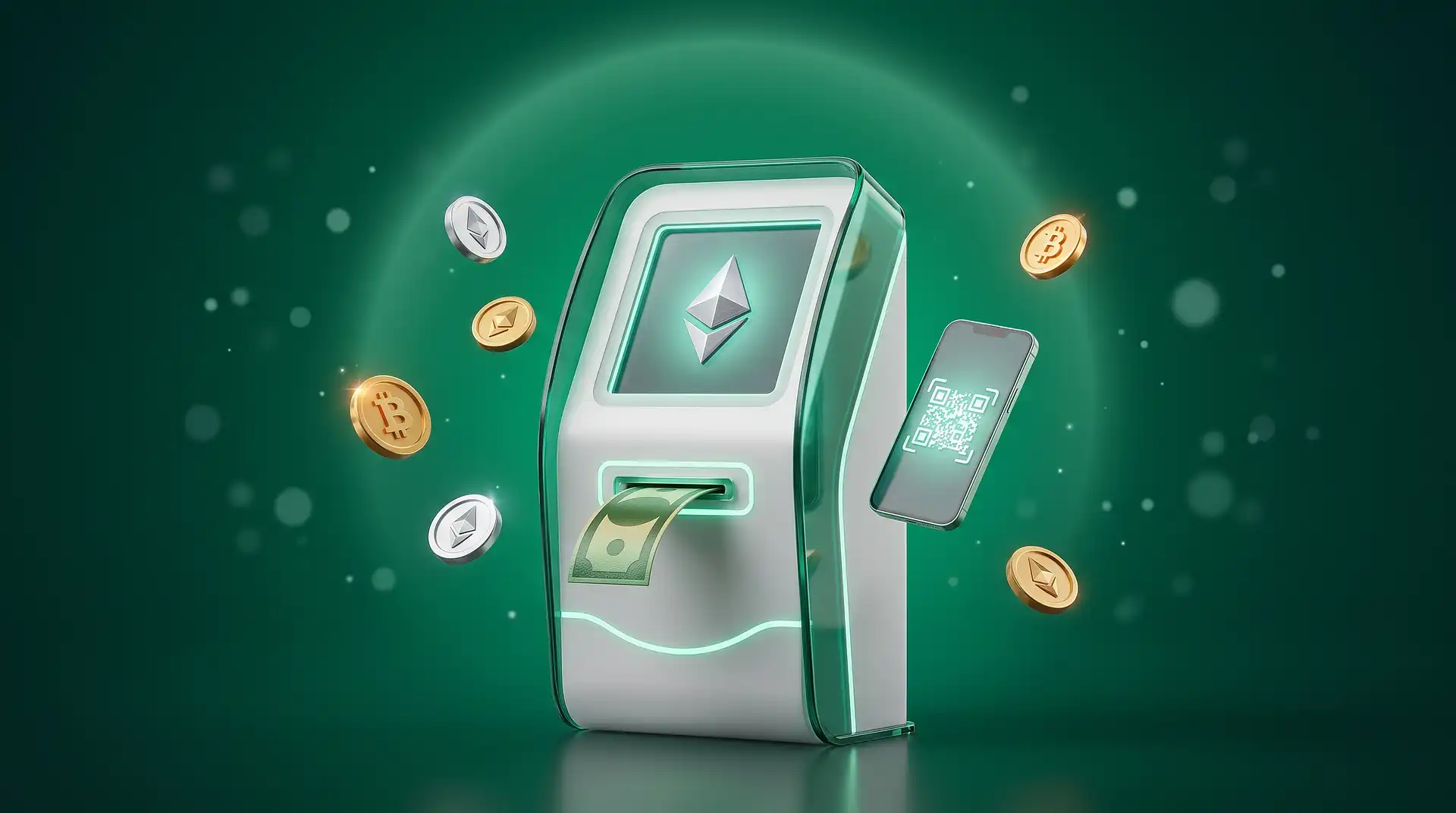
An Ethereum ATM is a crypto kiosk that lets you buy ether (ETH) with cash and send it straight to your own wallet. Many of the machines people call “Bitcoin ATMs” also sell ETH. Coin ATM Radar data reported in March 2026 showed ETH available at about 22,200 crypto ATM locations, more than half of all machines, and the US has the large majority of crypto ATMs worldwide.
Using an Ethereum ATM is quick, but it is not cheap, and it is one of the most common tools scammers ask victims to use. This guide shows you how to find an ETH machine near you, exactly how a purchase works step by step, what fees and limits to expect, which state laws now apply, why so many machines disappeared in 2026, and the warning signs that mean you should walk away.
What an ETH Crypto Kiosk Is and How It Works
A crypto ATM is not a bank ATM. It does not connect to your bank account or give you a card. Instead, it works like a vending machine for cryptocurrency: you feed in cash (or sometimes use a debit card), and the machine’s operator sends crypto to a wallet address you provide.
Most machines are one-way, which means you can only buy. Some are two-way and also let you sell crypto for cash. Each machine is run by an operator company, which sets the prices, fees and limits, and which must follow US money transmission rules.
Who runs crypto ATMs
A handful of companies run most US crypto ATMs. In March 2026, Coin ATM Radar data reported by Bitcoin.com News listed the largest operators worldwide as shown below. The list has changed a lot since then.
| Operator | Machines (March 2026) | Share of global total |
|---|---|---|
| Bitcoin Depot (shut down May 2026) | 9,246 | 23.8% |
| CoinFlip | 5,493 | 14.1% |
| Athena Bitcoin | 4,045 | 10.4% |
| RockItCoin | 2,757 | 7.1% |
| Bitstop | 2,372 | 6.1% |
| Margo | 2,138 | 5.5% |
Two big changes followed. On May 18, 2026, Bitcoin Depot, then the largest operator, filed for Chapter 11 bankruptcy and shut down its network of more than 9,000 kiosks. In October 2026, Coinme, which runs about 6,000 kiosks through a partnership with Coinstar, agreed with 34 state regulators to close its kiosks in those states by January 1, 2027. Not every machine from every operator sells ETH either, so always check the coin list for the specific location before you go.
Plainly put
A crypto ATM is the most expensive way to buy ETH and a favorite tool of scammers, so only ever use one to send ETH to your own wallet.
How many crypto ATMs sell ETH
The network has shrunk sharply. Coin ATM Radar counted 38,928 crypto ATMs worldwide in late March 2026, with about 22,200 of them supporting ETH. By late September 2026, after the Bitcoin Depot shutdown and new state bans, the global count had fallen to about 27,400, a level last seen in 2021, according to Bitcoin.com News. About 71% of the remaining machines are in the United States. There are fewer ETH machines than before, but if you live in or near a US city, one may still be within driving distance.
How to Find an Ethereum ATM Near Me
Finding an ETH machine takes a couple of minutes if you use the right tools. The aim is to find a machine that is open, sells ETH, and has fees you are comfortable with, before you leave home.
Use a crypto ATM map
ATM directory sites such as Coin ATM Radar let you filter machines by location, operator and supported coins. Filter for ETH, then check whether the machine is buy-only or two-way. Directory listings are not always up to date, so treat them as a starting point. This matters more than ever in 2026, after thousands of machines were switched off.
Check the operator’s own locator
Operators such as CoinFlip, Athena Bitcoin, RockItCoin and Bitstop run their own location finders. These usually show opening hours, supported coins, and sometimes current prices. Many machines sit inside convenience stores, gas stations or grocery stores, so the store’s hours apply.
Call or check before you travel
Before making a trip, confirm three things: that the machine is working, that it sells ETH right now, and what the purchase limit is for a new customer. Some states now limit how much a new customer can buy per day, as explained below.
Check whether your state allows crypto ATMs
A growing number of states have banned crypto kiosks outright. According to AARP, Indiana became the first state to ban them statewide in March 2026. Tennessee’s ban took effect on July 1, 2026, Minnesota banned kiosk operations from August 1, 2026, and Vermont has a moratorium on new kiosks, according to Bitcoin.com News. Several cities, including Spokane, Washington and St. Paul, Minnesota, voted to ban them in 2025. If no machines show up in your area, this may be why.
How to Buy ETH at a Crypto ATM, Step by Step
The exact screens vary by operator, but almost every purchase follows the same pattern. Read through the steps before you go so you are not rushed at the machine.
- Set up your own Ethereum wallet first. You need a wallet address to receive the ETH. Use a wallet you control and have backed up. Our wallet setup guide covers the basics.
- Get your receiving address ready as a QR code. Open your wallet, choose ETH on the Ethereum network, and tap Receive. Most machines scan the QR code with a camera.
- Choose ETH on the machine’s screen. Make sure you select ether and not another coin.
- Enter your phone number. Most operators send a verification code by text.
- Verify your identity if asked. Depending on the amount and your state, you may need to scan a photo ID or take a selfie.
- Scan your wallet QR code. Check that the address on screen matches your wallet. Never scan a QR code someone else gave you.
- Review the quote. The screen should show the ETH amount, the exchange rate and the fees. If the price looks far above the market price, stop.
- Insert cash. Most machines accept bills only and do not give change.
- Confirm and keep the receipt. The receipt is your record if anything goes wrong.
- Check your wallet. ETH usually arrives within minutes once the transaction confirms on the network.
Make sure your wallet uses the right network
ETH can exist on several networks, including Ethereum’s main network and other “layer 2” networks that use the same style of address. A crypto ATM normally sends ETH on the Ethereum main network. If your wallet or exchange account expects ETH on a different network, the funds may not show up or may be hard to recover. When in doubt, use a wallet set to the Ethereum main network and test with a small amount first.
Selling ETH at a two-way machine
On a two-way machine, the process reverses. You choose Sell, the machine shows you an address, you send ETH from your wallet, and once the transaction confirms the machine dispenses cash. Sell prices are usually lower than market prices, so compare the quote with the live price.
Buying ETH vs Bitcoin at a Crypto Kiosk
Most crypto ATMs started as Bitcoin machines, and many people use them for both coins. The buying process is almost the same, but a few differences matter when you buy ETH.
Address format. An Ethereum address looks different from a Bitcoin address. Ethereum addresses start with “0x,” while modern Bitcoin addresses usually start with “bc1.” If you scan a Bitcoin address while buying ETH, or the other way round, the machine should reject it, but always check the coin and address type before confirming.
Speed. Ethereum produces new blocks more often than Bitcoin, so ETH purchases often confirm faster. In both cases, network congestion can slow things down.
Network fees. Every transaction on Ethereum needs a network fee, often called “gas,” paid in ETH. When you buy at an ATM, the operator covers this and builds it into your price. Later, when you send ETH or use tokens on Ethereum, you will need a little ETH in your wallet to pay gas. Ethereum.org notes that you need some ETH in your wallet to use Ethereum applications.
Tokens. Some machines also sell tokens that run on Ethereum, such as certain stablecoins. If you buy one of these, you will still need some ETH in the same wallet to move it later.
Fees and Limits at ETH Crypto Kiosks
Convenience is the main reason to use a crypto ATM, and you pay for it. Fees are much higher than on most online exchanges, and limits depend on the operator and your state.
How much crypto ATMs charge
Crypto ATM fees are usually built into the exchange rate rather than shown as a separate line, which makes them easy to miss. Milk Road’s crypto ATM guide puts typical fees at around 15% of the transaction when buying. That means $100 in cash might buy only about $85 worth of ETH at market prices.
Some states now cap fees. California’s Digital Financial Assets Law limits single-transaction charges at kiosks to the greater of $5 or 15% of the transaction value, effective January 1, 2025, and requires operators to show fees and the spread on receipts.
Daily purchase limits
Limits come from two places: the operator’s own rules and state law. Examples of state rules include:
| State | Rule | Source |
|---|---|---|
| California | $1,000 per customer per day (since January 1, 2024) | California DFPI |
| Virginia | $2,000 a day for new customers, $5,000 for existing customers | AARP |
| Indiana | Machines banned statewide (signed March 9, 2026) | AARP |
| Tennessee | Machines banned (effective July 1, 2026) | Bitcoin.com News |
| Minnesota | Kiosk operations banned from August 1, 2026 | Bitcoin.com News |
AARP reports that 35 states have passed crypto kiosk laws since 2023, including 18 in 2026 alone. Common provisions include daily limits, fraud warning signs, operator licensing and detailed receipts. Rules are changing quickly, so check your own state before a large purchase.
Identity checks
Crypto ATM operators are money services businesses under federal rules. FinCEN’s 2025 notice on crypto kiosks reminded operators that they must register with FinCEN and follow Bank Secrecy Act requirements, which include collecting customer information. Expect to give at least a phone number, and often a photo ID for larger amounts.
Is Using a Crypto ATM for ETH Safe?
The machines themselves are legal where permitted, and buying ETH for yourself with your own cash can be done safely. The risk is that crypto ATMs have become a favorite payment method for scammers, because payments are fast, hard to reverse and can be sent to an address the scammer controls.
What the fraud figures show
Official data shows how serious the problem is:
- In 2024, the FTC reported that fraud losses at Bitcoin ATMs grew nearly tenfold from 2020 to 2023, topping $65 million in the first half of 2024 alone, with a median reported loss of $10,000.
- In that period, people aged 60 and over were more than three times as likely as younger adults to report losing money at these machines.
- The FBI attributed more than $389 million in 2025 losses to scams involving crypto kiosks, from over 13,460 complaints, according to AARP. Adults 60 and older accounted for 76% of losses where age was known.
- In 2025, Iowa’s attorney general sued Bitcoin Depot and CoinFlip, saying her investigation found at least 95% of transactions at their machines in the state were fraudulent, costing Iowans about $20 million in less than three years, according to AARP.
The scams to watch for
The FTC found that government impersonation, business impersonation and tech support scams made up about 86% of reports involving crypto ATM losses. They usually follow a script:
- Someone calls, texts or shows a pop-up saying your bank account, computer or identity has a problem.
- They say you must withdraw cash and put it into a crypto ATM to “protect” it or fix the problem.
- They send you a QR code to scan at the machine.
- They stay on the phone and pressure you to hurry.
The one rule that stops most scams
The FTC is clear: real businesses and government agencies never ask you to pay with a crypto ATM, gift cards, or by moving money to “protect” it. If anyone tells you to put cash into a crypto ATM, stop, hang up, and contact your bank or the agency directly using a number you look up yourself. Never scan a QR code someone else sent you.
Crypto ATM vs Exchange for Buying ETH
A crypto ATM is not the only way to buy ETH, and for most people it is not the cheapest. Here is how the main options compare.
| Factor | Crypto ATM | Online exchange or app |
|---|---|---|
| Payment | Cash (sometimes debit card) | Bank transfer, debit card |
| Typical cost | Often around 15% built into the price | Usually much lower |
| Speed | Minutes, at the machine | Minutes once your account is verified |
| Identity checks | Phone number, often ID | Full identity verification |
| Limits | Operator and state daily limits | Usually higher |
| Reversibility | None once sent | Depends on platform rules |
| Scam risk | High if someone else directs you | Lower, but still check links |
A crypto ATM can make sense if you only have cash, do not want to link a bank account, or need ETH quickly in a small amount. For regular purchases, an exchange usually costs far less.
Tips Before You Use an ETH Machine
A few minutes of preparation can save you money and protect you from mistakes.
- Compare the machine’s price with the live market price on a price site before you insert cash.
- Start small the first time to make sure the ETH arrives where you expect.
- Use only your own wallet, and double-check the address on screen.
- Bring exact bills, since many machines do not give change.
- Keep every receipt in case of a dispute or for your tax records.
- Never buy crypto because someone told you to, especially on the phone.
- Report suspected fraud to the FBI’s Internet Crime Complaint Center (ic3.gov) and the FTC.
What to Do If Your ETH Does Not Arrive
Most purchases arrive within minutes. If yours does not, work through these steps before assuming the worst.
- Wait a little longer. During busy periods on the Ethereum network, confirmation can take more time.
- Find the transaction ID on your receipt. Many receipts include a transaction hash, a long code starting with “0x.”
- Look it up on a block explorer. Paste the transaction ID into an Ethereum block explorer such as Etherscan. It will show whether the transaction is pending, confirmed, or failed, and which address received the ETH.
- Check the address. Compare the receiving address on the explorer with your wallet address. If they match and the transaction is confirmed, the ETH is in your wallet; your app may just need to refresh or add the right network.
- Contact the operator. If the transaction never appears, call the operator’s support line printed on the machine or receipt. Have your receipt, the machine location and the time ready.
- Keep records of every contact. If you cannot resolve it, you can file a complaint with your state’s financial regulator.
If the ETH went to an address that someone else gave you, contact the operator at once and report it to ic3.gov. Do not pay anyone who contacts you offering to get it back. Our guide to crypto recovery scams explains why.
Taxes on ETH Bought With Cash
Buying ETH with cash is not a taxable event by itself in the US. But the IRS treats digital assets as property, so selling, trading or spending your ETH later can create a taxable gain or loss. Keep a record of the date, the amount you paid including fees, and how much ETH you received. Your ATM receipt is a useful starting point.
Frequently Asked Questions
These are the questions people ask most often about buying ETH at a crypto ATM.
Many do. In March 2026, about 22,200 crypto ATM locations worldwide supported ETH, according to Coin ATM Radar data. Thousands of machines have closed since then, so check the specific machine’s coin list before you go.
Costs vary by operator, but fees are typically built into the price and are much higher than on exchanges. Milk Road puts typical buying fees around 15%. California caps kiosk fees at the greater of $5 or 15%.
For small amounts, some operators only require a phone number. Larger amounts and some states require ID. Operators must follow federal recordkeeping rules.
Usually a few minutes, once the transaction is confirmed on the Ethereum network. Network congestion can add time.
Only at two-way machines. Check the location listing for “buy and sell” before you go.
In most states, yes, as long as the operator is registered with FinCEN and holds any license the state requires. However, Indiana, Tennessee and Minnesota banned crypto kiosks in 2026, and several cities and counties have banned them too, so availability depends on where you live.
The operator builds its fee and the network fee into the price, and adds a margin for the cost of running the machine and handling cash. That is why the rate on screen is usually well above the price you see on a market data site.
Most crypto ATMs take cash only, and some accept debit cards. Credit cards are rarely accepted, and even where they are, your card issuer may treat the purchase as a cash advance with extra fees and interest. Cash or a debit card is the usual choice.
Minimums depend on the machine and the operator. Many let you start with a single small bill, but fees can take a large share of a very small purchase, so check the quote first.
Contact the ATM operator immediately with your receipt, report the scam to ic3.gov and the FTC, and be very wary of anyone who later offers to recover your money for a fee.
Final Thoughts
An Ethereum ATM is a fast way to turn cash into ETH, and even after the 2026 closures, many US machines still sell it. Find a machine through a directory or operator locator, have your own wallet’s QR code ready, check the quote against the market price, and keep your receipt.
Go in with realistic expectations about cost, since fees are much higher than online exchanges, and check your state’s limits and rules. Above all, remember that no legitimate company or government agency will ever tell you to pay through a crypto ATM.
Sources
- Bitcoin.com News: Crypto ATM count falls to 38,928 (March 2026)
- Bitcoin.com News: Global crypto ATMs fall to 27,945 (July 2026)
- Bitcoin.com News: Crypto ATM numbers fall to 2021 levels (September 2026)
- AARP: How states are taking aim at crypto ATM fraud
- AARP: 9,000 crypto kiosks go dark amid a fraud crackdown
- GN Crypto News: Coinme to shut crypto kiosks in $2.5M settlement
- California DFPI: Court upholds daily limit for crypto kiosks
- FTC: Bitcoin ATMs, a payment portal for scammers
- The Block: FBI says crypto fraud losses hit a record in 2025
- FinCEN: Notice on crypto kiosk scams (FIN-2025-NTC1)
- Ethereum.org: Wallets
- IRS: Digital assets
Disclaimer: This article is for general information only and is not financial, legal or tax advice. Crypto ATM laws, fees and limits change often; check current rules in your state.